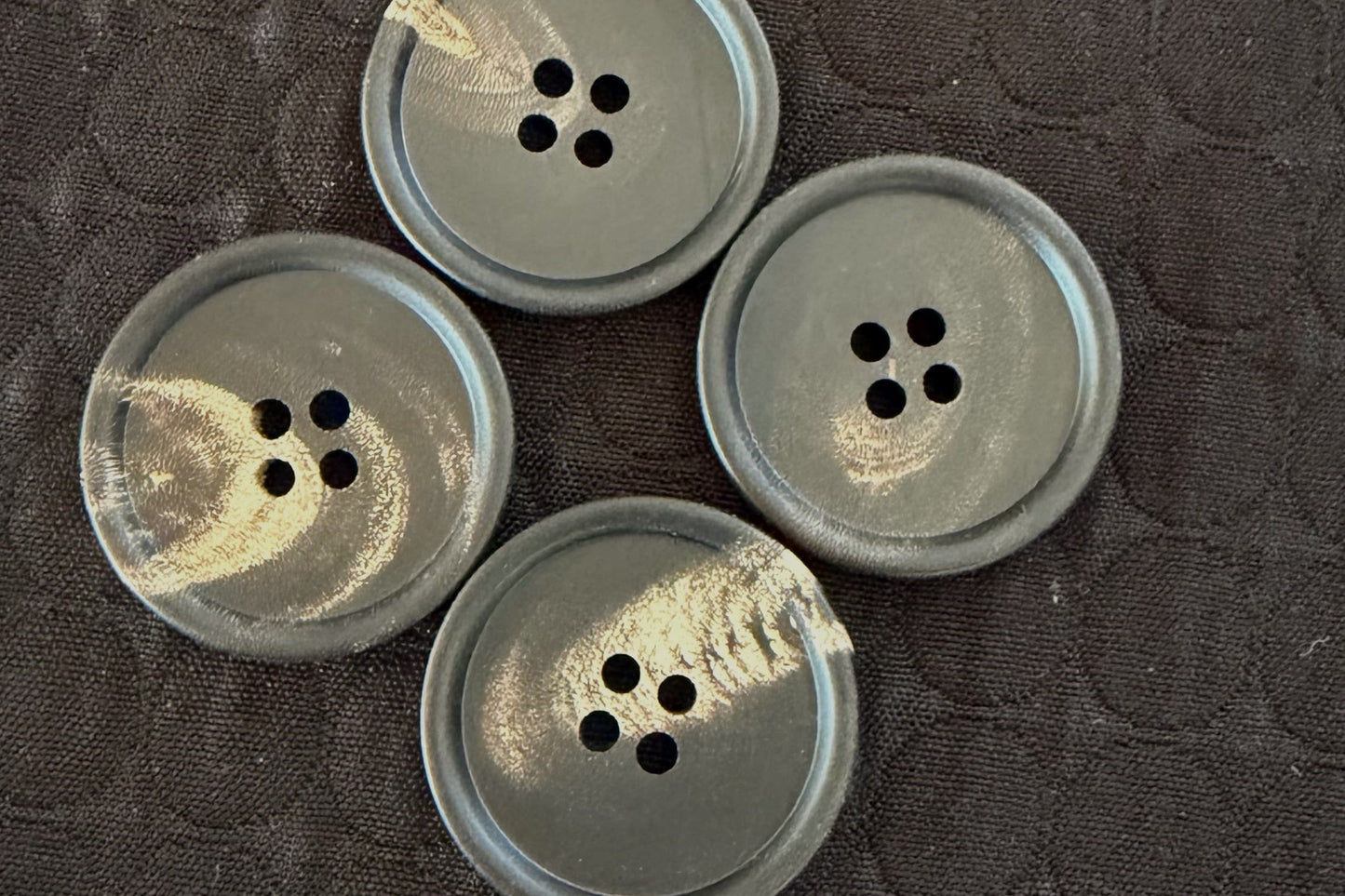
Pushing Buttons – October
Share
Turns out one of the hardest parts of starting a button store is also the hardest part of running a consultancy (my day job) – pricing.
Where do people learn how to price stuff? Is there a secret course that I missed? Is everyone just asking Claude like I am?
Well, yes, I asked Claude about standard mark-ups. To explain "landed cost". About how to deal with exchange rates and taxes. I also need to track the cost of the packaging, which is small but matters when you can literally buy one button from me. And then I asked myself how much I would pay, which for just about everything is less than other people would.
Here’s where AI made my life so much easier in the early days. I gave it my invoices, and it created a spreadsheet that had a line item for each button, distributed the shipping and brokerage costs, kept track of the currencies and then added my standard mark-up.
That worked for the buttons I bought straight from manufacturers (mostly horn and corozo). But I also bought a lot of buttons second-hand off Facebook. Stashes from dead grandmothers, sewists who bought far more than they could ever use. But applying the same margin didn’t make sense. They are unused. Unique. Pricing them much lower than the buttons that were imported would create an odd disparity. And of course there’s a point at which a sale is not worth the drive to the post office.
So pricing became part arithmetic, part instinct. I had a ceiling in mind for the price of a single button, pinching the margin on a few buttons (ironically, the ones that are the most beautiful) to stick to that.
And then there is the value of my time. Every button gets photographed, described, numbered (did you know that SKUs can literally just be made up?) and tucked away for storage before it ever appears in the shop. In the early days, one listing could take me half an hour. I'm quicker now, but some of those buttons will only ever sell once, so all the set-up time is lost. Packing orders takes more time; each sale is placed in a handmade envelope and packed with a handwritten note.
Have I got it right? Who knows. It will take more time and more data to tell. What I have learned is that you love the corozo and horn buttons as much as I do (see my bestsellers below), and that you value natural materials and sustainability.
I've also made peace with something: this shop will probably never pay me for my time, and I'm fine with that. It's where I get to learn, experiment and have fun – and share a few beautiful things along the way.